Why porn blockers stop working after two weeks
Blocker apps fail in a predictable pattern — and it is not because you lack willpower. A look at what actually breaks, and why a ten-second delay survives where a lockout does not.
You install the blocker on a Sunday, feeling decisive. You set it to maximum strength. For nine days it works beautifully.
Then one evening you find yourself in Settings, uninstalling it — calmly, almost administratively, as if you were tidying up. Later you cannot really explain what happened. You conclude you are the problem.
You are not. That sequence is so consistent it may as well be a spec.
The blocker's bargain
A hard blocker makes a specific trade: it takes the decision away from you now, in exchange for you having decided once, earlier, while calm. That is a real and sometimes excellent trade — it is the whole logic behind Ulysses tying himself to the mast.
But an app on your own phone is a mast you can untie, and this is where the trade breaks down in three ways.
It creates an adversary. The moment something on your phone tells you no, part of you starts treating it as an opponent. And that part is resourceful. People who cannot summon the energy to reply to an email will, at midnight, discover airplane mode, DNS bypass, a second browser, a work profile, an ADB command. The energy is not the issue — the framing is. You have turned a self-control problem into a puzzle, and puzzles are fun.
It never gets tested until it fails. A blocker gives you no feedback while it holds. You cannot see the urges bouncing off it, so you never learn how often they come, when, or what triggers them. Then one gets through, and because you have no record of the nine days it held, that single failure feels like proof that nothing works.
It punishes the ordinary use of the same tool. The browser you blocked is also the browser you need for the recipe, the bank, the boarding pass. Every legitimate use is a small tax, and taxes accumulate resentment. Eventually removing it feels like relief rather than surrender — that is the calm uninstall.
What is actually happening in the moment
Ask someone what they were thinking right before a relapse and you usually get nothing, because nothing was thought. The phone was in hand for another reason. There was a gap — a boring meeting, a hard task, a lonely hour, the ten minutes before sleep. The thumb moved through a sequence it has performed a thousand times, and awareness arrived somewhere around the third tap.
That is not a values failure. It is a reflex, and reflexes have one exploitable property:
They are fast, and they cannot wait.
An urge acted on instantly feels overwhelming. The same urge held for ten seconds — not fought, not argued with, just held — is noticeably weaker, because the part of you that has opinions about your life gets time to arrive. Nobody has ever won an argument with a craving in the first half-second. Most people win easily by the tenth.
Friction instead of a wall
So invert the design. Do not stop the action. Slow it down.
That is the model behind TemptShield. You flag the apps that pull you in. When one opens, a full-screen pause appears over it with a countdown — "Close it" works instantly, "Open anyway" unlocks when the timer ends. Every attempt is recorded as tackled or opened anyway.
Three things change compared to a blocker:
There is no adversary. You always keep the final say, so there is nothing to defeat and nothing to circumvent. The puzzle-solving part of your brain never activates, because there is no puzzle — only a slower door. The urge to uninstall never really shows up, which is exactly why the tool is still installed in month three.
You get data instead of shame. Today's tackled count, a weekly and monthly "% resisted", per-app totals. Suddenly you can see that Tuesday evenings are hard, that one particular app accounts for most of it, that you beat eleven of fourteen urges this week. That is a completely different self-image from "I failed on Thursday". And nobody else ever sees it — there is no account, no server, no accountability report, because there is nobody to send one to.
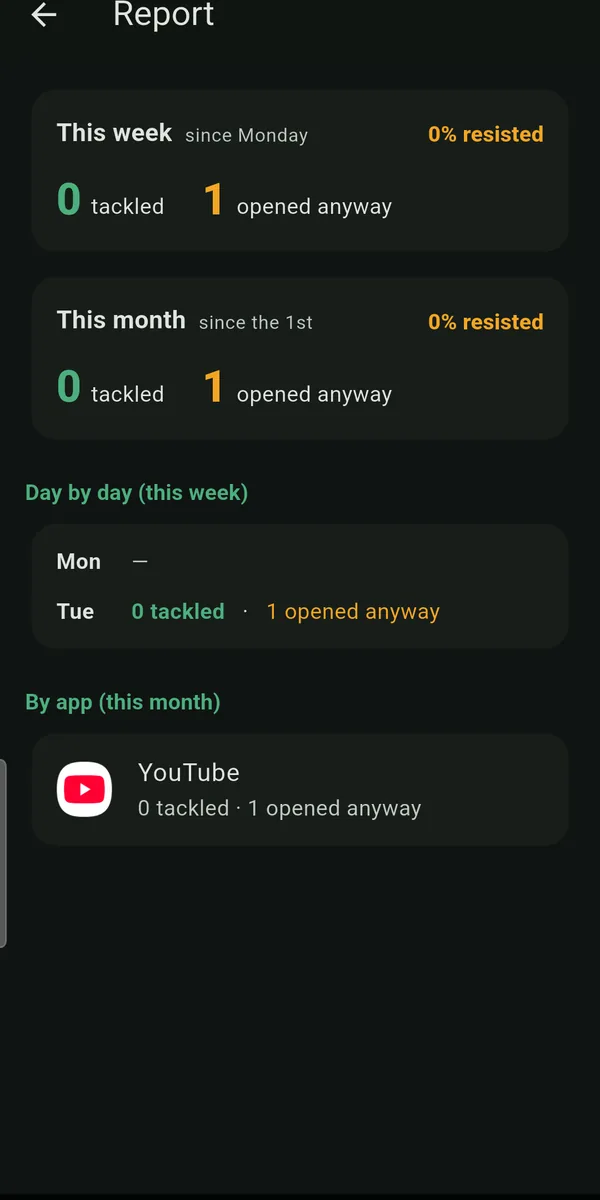
Slips stay in the system. Waiting out the timer is a recorded, permitted outcome, not a breach that ends the experiment. This matters more than it sounds: a system you can slip inside of is a system you keep using, and the one that is still running next month is the one that changes anything.
Tuning it over time
Friction is a dial, not a switch. TemptShield lets you set the wait from 3 to 60 seconds and the "Open anyway" pass from 1 to 60 minutes.
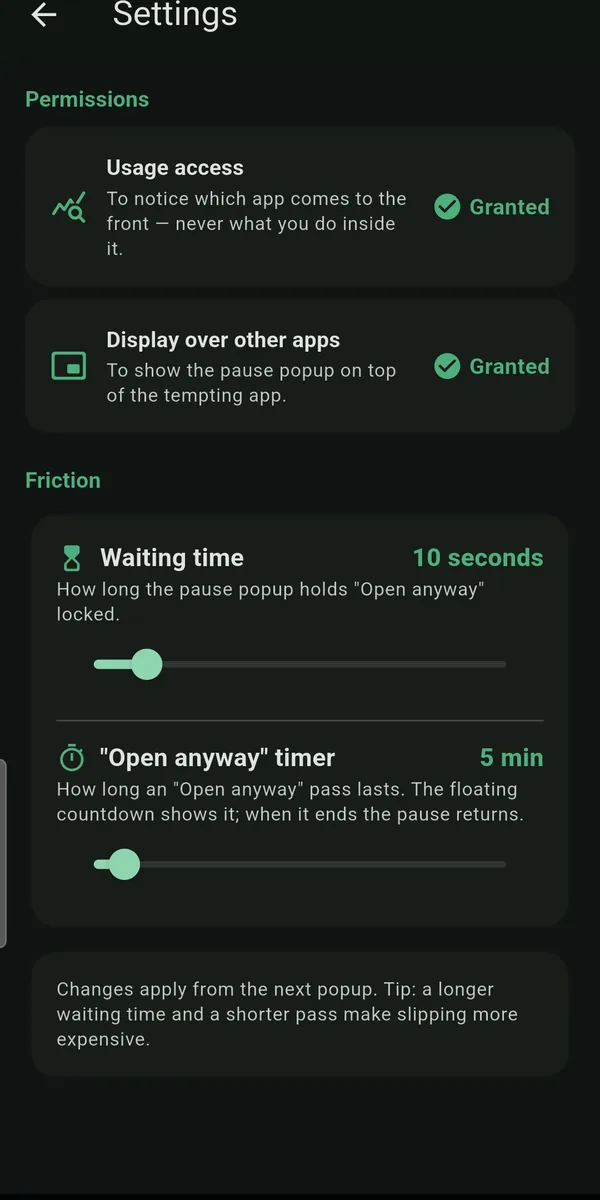
Start gentle. Ten seconds and a long pass while the habit is raw — you are trying to build the pause into the routine, not to win immediately. Once the pause feels normal, tighten it: thirty seconds, a five-minute pass. Each notch makes slipping more expensive without ever making it impossible.
If you also want the supply side handled, Android's built-in Private DNS setting with a filtering resolver covers adult sites device-wide, and TemptShield shows you a red warning card whenever that setting gets switched off — the full setup is here. The filtering is done by the resolver you choose in Android's own settings; what the app adds is that the toggle can no longer be flipped quietly.
The honest limits
Friction will not fix a habit that is doing a job for you. If the phone is how you handle loneliness, anxiety or a life you would rather not sit still inside, delaying it by ten seconds will surface that fact rather than solve it — which is uncomfortable, and also useful information. Take it to a therapist rather than to a bigger blocker.
And if you have already tried three blockers and uninstalled all three: that is not evidence about you. It is evidence about blockers.